New York City
The Greatest City in the World

New York City (NYC), often called the City of New York or simply New York (NY), is the most populous city in the United States. With an estimated 2018 population of 8,398,748 distributed over about 302.6 square miles (784 km2), New York is also the most densely populated major city in the United States. Located at the southern tip of the U.S. state of New York, the city is the center of the New York metropolitan area, the largest metropolitan area in the world by urban landmass. With almost 20 million people in its metropolitan statistical area and approximately 23 million in its combined statistical area, it is one of the world's most populous megacities. New York City has been described as the cultural, financial, and media capital of the world, significantly influencing commerce, entertainment, research, technology, education, politics, tourism, art, fashion, and sports. Home to the headquarters of the United Nations, New York is an important center for international diplomacy.
Situated on one of the world's largest natural harbors, New York City is composed of five boroughs, each of which is a county of the State of New York. The five boroughs—Brooklyn, Queens, Manhattan, the Bronx, and Staten Island—were consolidated into a single city in 1898. The city and its metropolitan area constitute the premier gateway for legal immigration to the United States. As many as 800 languages are spoken in New York, making it the most linguistically diverse city in the world. New York is home to more than 3.2 million residents born outside the United States, the largest foreign-born population of any city in the world as of 2016. As of 2019, the New York metropolitan area is estimated to produce a gross metropolitan product (GMP) of $2.0 trillion. If the New York metropolitan area were a sovereign state, it would have the 8th largest economy in the world. New York is home to the highest number of billionaires of any city in the world.
Many districts and landmarks in New York City are well known, including three of the world's ten most visited tourist attractions in 2013. A record 62.8 million tourists visited New York City in 2017. Times Square is the brightly illuminated hub of the Broadway Theater District, one of the world's busiest pedestrian intersections, and a major center of the world's entertainment industry. Many of the city's landmarks, skyscrapers, and parks are known around the world. Manhattan's real estate market is among the most expensive in the world. New York is home to the largest ethnic Chinese population outside of Asia, with multiple distinct Chinatowns across the city. Providing continuous 24/7 service and contributing to the nickname The City that Never Sleeps, the New York City Subway is the largest single-operator rapid transit system worldwide, with 472 rail stations. The city has over 120 colleges and universities, including Columbia University, New York University, Rockefeller University, and the City University of New York system, which is the largest urban public university system in the United States. Manhattan is home to the world's two largest stock exchanges by total market capitalization, namely the New York Stock Exchange, located on Wall Street in the Financial District of Lower Manhattan, and NASDAQ, headquartered in Midtown Manhattan.
From Wikipedia, the free encyclopedia
History
Etymology
In 1664, the city was named in honor of the Duke of York, who would become King James II of England. James's older brother, King Charles II, had appointed the Duke proprietor of the former territory of New Netherland, including the city of New Amsterdam, which England had recently seized from the Dutch.
Early History
In the precolonial era, the area of present-day New York City was inhabited by Algonquian Native Americans, including the Lenape. Their homeland, known as Lenapehoking, included Staten Island, Manhattan, the Bronx, the western portion of Long Island (including the areas that would later become the boroughs of Brooklyn and Queens), and the Lower Hudson Valley.
The first documented visit into New York Harbor by a European was in 1524 by Giovanni da Verrazzano, a Florentine explorer in the service of the French crown. He claimed the area for France and named it Nouvelle Angoulême (New Angoulême). A Spanish expedition, led by the Portuguese captain Estêvão Gomes sailing for Emperor Charles V, arrived in New York Harbor in January 1525 and charted the mouth of the Hudson River, which he named Río de San Antonio (Saint Anthony's River). The Padrón Real of 1527, the first scientific map to show the East Coast of North America continuously, was informed by Gomes' expedition and labeled the northeastern United States as Tierra de Esteban Gómez in his honor.
The first non-Native American inhabitant of what would eventually become New York City was Juan Rodriguez (transliterated to Dutch as Jan Rodrigues), a merchant from Santo Domingo. Born in Santo Domingo of Portuguese and African descent, he arrived in Manhattan during the winter of 1613–14, trapping for pelts and trading with the local population as a representative of the Dutch. Broadway, from 159th Street to 218th Street in Upper Manhattan, is named Juan Rodriguez Way in his honor.
Dutch Rule
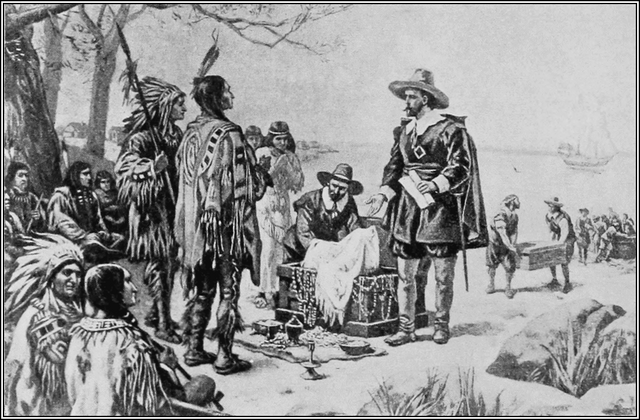
A permanent European presence in New Netherland began in 1624—making New York the 12th oldest continuously occupied European-established settlement in the continental United States—with the founding of a Dutch fur trading settlement on Governors Island. In 1625, construction was started on a citadel and Fort Amsterdam, later called Nieuw Amsterdam (New Amsterdam), on present-day Manhattan Island. The colony of New Amsterdam was centered on what would later be known as Lower Manhattan. It extended from the lower tip of Manhattan to modern day Wall Street, where a 12-foot wooden stockade was built in 1653 to protect against Native American and British raids. In 1626, the Dutch colonial Director-General Peter Minuit, acting as charged by the Dutch West India Company, purchased the island of Manhattan from the Canarsie, a small Lenape band, for "the value of 60 guilders" (about $900 in 2018).[60] A disproved legend claims that Manhattan was purchased for $24 worth of glass beads.
Following the purchase, New Amsterdam grew slowly. To attract settlers, the Dutch instituted the patroon system in 1628, whereby wealthy Dutchmen (patroons, or patrons) who brought 50 colonists to New Netherland would be awarded swaths of land, along with local political autonomy and rights to participate in the lucrative fur trade. This program had little success.
Since 1621, the Dutch West India Company had operated as a monopoly in New Netherland, on authority granted by the Dutch States General. In 1639–1640, in an effort to bolster economic growth, the Dutch West India Company relinquished its monopoly over the fur trade, leading to growth in the production and trade of food, timber, tobacco, and slaves (particularly with the Dutch West Indies).
Geography
During the Wisconsin glaciation, 75,000 to 11,000 years ago, the New York City area was situated at the edge of a large ice sheet over 2,000 feet (610 m) in depth. The erosive forward movement of the ice (and its subsequent retreat) contributed to the separation of what is now Long Island and Staten Island. That action also left bedrock at a relatively shallow depth, providing a solid foundation for most of Manhattan's skyscrapers.

New York City is situated in the northeastern United States, in southeastern New York State, approximately halfway between Washington, D.C. and Boston. The location at the mouth of the Hudson River, which feeds into a naturally sheltered harbor and then into the Atlantic Ocean, has helped the city grow in significance as a trading port. Most of New York City is built on the three islands of Long Island, Manhattan, and Staten Island.
The Hudson River flows through the Hudson Valley into New York Bay. Between New York City and Troy, New York, the river is an estuary. The Hudson River separates the city from the U.S. state of New Jersey. The East River—a tidal strait—flows from Long Island Sound and separates the Bronx and Manhattan from Long Island. The Harlem River, another tidal strait between the East and Hudson Rivers, separates most of Manhattan from the Bronx. The Bronx River, which flows through the Bronx and Westchester County, is the only entirely fresh water river in the city.
The city's total area is 468.484 square miles (1,213.37 km2), including 302.643 sq mi (783.84 km2) of land and 165.841 sq mi (429.53 km2) of this is water. The highest point in the city is Todt Hill on Staten Island, which, at 409.8 feet (124.9 m) above sea level, is the highest point on the Eastern Seaboard south of Maine. The summit of the ridge is mostly covered in woodlands as part of the Staten Island Greenbelt.
Demographics
New York City is the most populous city in the United States, with an estimated 8,336,817 residents as of July 2019, incorporating more immigration into the city than outmigration since the 2010 United States Census. More than twice as many people live in New York City as compared to Los Angeles, the second-most populous U.S. city, and within a smaller area. New York City gained more residents between April 2010 and July 2014 (316,000) than any other U.S. city. New York City's population is about 43% of New York State's population and about 36% of the population of the New York metropolitan area.
Population density
In 2017, the city had an estimated population density of 28,491 inhabitants per square mile (11,000/km2), rendering it the nation's most densely populated of all municipalities (of more than 100,000), with several small cities (of fewer than 100,000) in adjacent Hudson County, New Jersey having greater density, as per the 2010 census. Geographically co-extensive with New York County, the borough of Manhattan's 2017 population density of 72,918 inhabitants per square mile (28,154/km2) makes it the highest of any county in the United States and higher than the density of any individual American city.
Race and Ethnicity
The city's population in 2010 was 44% white (33.3% non-Hispanic white), 25.5% black (23% non-Hispanic black), 0.7% Native American, and 12.7% Asian. Hispanics of any race represented 28.6% of the population, while Asians constituted the fastest-growing segment of the city's population between 2000 and 2010; the non-Hispanic white population declined three percent, the smallest recorded decline in decades; and for the first time since the Civil War, the number of blacks declined over a decade. Throughout its history, New York has been a major port of entry for immigrants into the United States. More than 12 million European immigrants were received at Ellis Island between 1892 and 1924. The term "melting pot" was first coined to describe densely populated immigrant neighborhoods on the Lower East Side. By 1900, Germans constituted the largest immigrant group, followed by the Irish, Jews, and Italians. In 1940, whites represented 92% of the city's population.

Approximately 37% of the city's population is foreign born, and more than half of all children are born to mothers who are immigrants. In New York, no single country or region of origin dominates. The ten largest sources of foreign-born individuals in the city as of 2011 were the Dominican Republic, China, Mexico, Guyana, Jamaica, Ecuador, Haiti, India, Russia, and Trinidad and Tobago, while the Bangladeshi-born immigrant population has become one of the fastest growing in the city, counting over 74,000 by 2011.
New York City has the largest European and non-Hispanic white population of any American city. At 2.7 million in 2012, New York's non-Hispanic white population is larger than the non-Hispanic white populations of Los Angeles (1.1 million), Chicago (865,000), and Houston (550,000) combined. The non-Hispanic white population was 6.6 million in 1940. The non-Hispanic white population has begun to increase since 2010.
Sexual Orientation and Gender Identity

The New York metropolitan area is home to a prominent self-identifying gay and bisexual community estimated at nearly 570,000 individuals, the largest in the United States and one of the world's largest. Same-sex marriages in New York were legalized on June 24, 2011 and were authorized to take place beginning 30 days thereafter. Charles Kaiser, author of The Gay Metropolis: The Landmark History of Gay Life in America, wrote that in the era after World War II, "New York City became the literal gay metropolis for hundreds of thousands of immigrants from within and without the United States: the place they chose to learn how to live openly, honestly and without shame."
The annual New York City Pride March (or gay pride parade) traverses southward down Fifth Avenue and ends at Greenwich Village in Lower Manhattan; the parade rivals the Sao Paulo Gay Pride Parade as the largest pride parade in the world, attracting tens of thousands of participants and millions of sidewalk spectators each June. The annual Queens Pride Parade is held in Jackson Heights and is accompanied by the ensuing Multicultural Parade. Stonewall 50 – WorldPride NYC 2019 was the largest international Pride celebration in history, produced by Heritage of Pride and enhanced through a partnership with the I ❤ NY program's LGBT division, commemorating the 50th anniversary of the Stonewall uprising, with 150,000 participants and five million spectators attending in Manhattan alone. New York City is also home to the largest transgender population in the world, estimated at more than 50,000 in 2018, concentrated in Manhattan and Queens; however, until the June 1969 Stonewall riots, this community had felt marginalized and neglected by the gay community.
Transportation
New York City's comprehensive transportation system is both complex and extensive.
Rapid Transit
Mass transit in New York City, most of which runs 24 hours a day, accounts for one in every three users of mass transit in the United States, and two-thirds of the nation's rail riders live in the New York City Metropolitan Area.
Rail
The iconic New York City Subway system is the largest rapid transit system in the world when measured by stations in operation, with 472, and by length of routes. Nearly all of New York's subway system is open 24 hours a day, in contrast to the overnight shutdown common to systems in most cities, including Hong Kong, London, Paris, Seoul, and Tokyo. The New York City Subway is also the busiest metropolitan rail transit system in the Western Hemisphere, with 1.76 billion passenger rides in 2015, while Grand Central Terminal, also referred to as "Grand Central Station", is the world's largest railway station by number of train platforms.

Public transport is essential in New York City. 54.6% of New Yorkers commuted to work in 2005 using mass transit. This is in contrast to the rest of the United States, where 91% of commuters travel in automobiles to their workplace. According to the New York City Comptroller, workers in the New York City area spend an average of 6 hours and 18 minutes getting to work each week, the longest commute time in the nation among large cities. New York is the only U.S. city in which a majority (52%) of households do not have a car; only 22% of Manhattanites own a car. Due to their high usage of mass transit, New Yorkers spend less of their household income on transportation than the national average, saving $19 billion annually on transportation compared to other urban Americans.
New York City's commuter rail network is the largest in North America. The rail network, connecting New York City to its suburbs, consists of the Long Island Rail Road, Metro-North Railroad, and New Jersey Transit. The combined systems converge at Grand Central Terminal and Pennsylvania Station and contain more than 250 stations and 20 rail lines. In Queens, the elevated AirTrain people mover system connects JFK International Airport to the New York City Subway and the Long Island Rail Road; a separate AirTrain system is planned alongside the Grand Central Parkway to connect LaGuardia Airport to these transit systems. For intercity rail, New York City is served by Amtrak, whose busiest station by a significant margin is Pennsylvania Station on the West Side of Manhattan, from which Amtrak provides connections to Boston, Philadelphia, and Washington, D.C. along the Northeast Corridor, and long-distance train service to other North American cities.
Buses
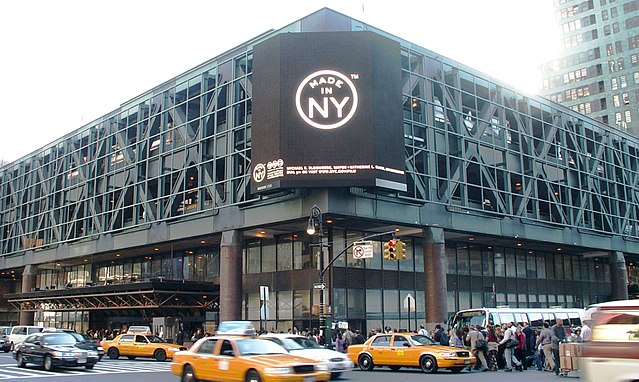
New York City's public bus fleet runs 24/7 and is the largest in North America. The Port Authority Bus Terminal, the main intercity bus terminal of the city, serves 7,000 buses and 200,000 commuters daily, making it the busiest bus station in the world.